



A collection of photos and poems interacting with each other in ways both mysterious and obvious.
He sits in the space where nothing begins,
A man folded into himself,
his hands still, as if waiting to explain
what the world refuses to ask.
The shutters are closed, the light withdrawn,
and yet the graffiti hums—
a hymn of guilt, a language he cannot speak,
scribbled by ghosts who pass unnoticed.
Behind him, the city vanishes,
its weight pressed into his spine.
He is no longer afraid of falling;
the earth has already claimed him.
Is this the moment the world forgets him?
Or the moment he forgets the world?
The air thickens with questions,
each heavier than the silence they fill.
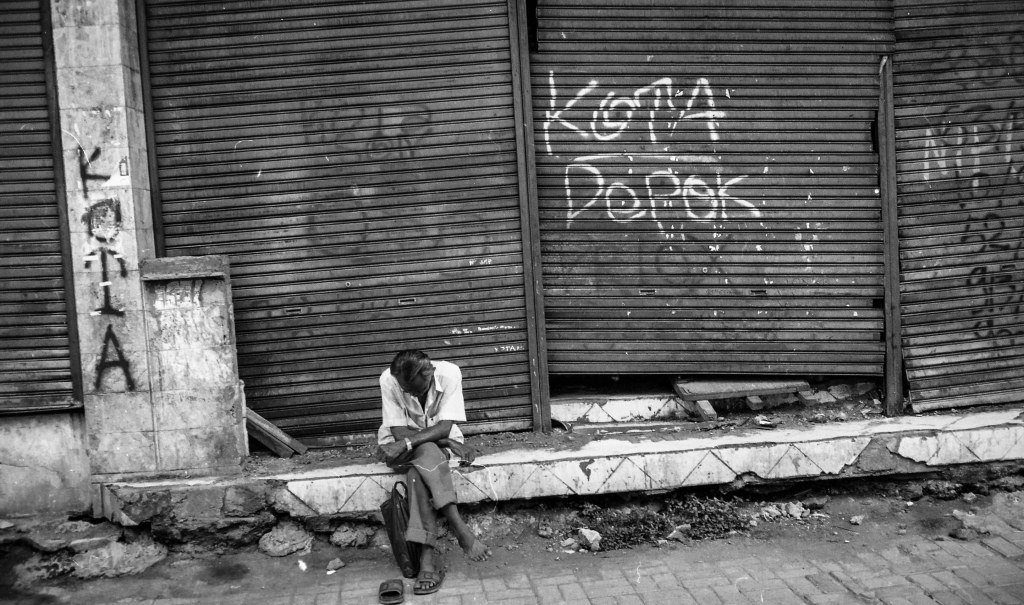
Kandy, Sri Lanka
Gull on Asphalt
it started with a crack of light,

a wet push into the cold,
and the sky—always the sky—

waiting to swallow you whole.
you learned fast.


claws on stone,
wings slicing the wind like knives.
you laughed at gravity,
but sickness hit like a sudden storm,
a sharp crack in the clear sky,
leaving you stunned, spiraling,
ground rushing up too fast to fight.


one day the wind felt heavier,

the horizon farther.
and then—this.


blood on the pavement,

feathers bent wrong,

the sky doesn’t even care.

Portland, Maine
Ennio Morricone’s contribution to the world of music, especially film music, stands as a testament to his unparalleled genius. Over a career spanning more than six decades, Morricone composed over 400 film and television scores, in addition to more than 100 classical works. His music is not just a backdrop to the films it accompanies; it is an integral part of the storytelling process, often conveying more emotion, tension, and drama than the dialogue or visuals themselves.
This week’s show features some of his greatest compositions, for film.
The playlist for the week of August 26, 2024 ☞
00:00:00 Ennio Morricone – The Ecstasy of Gold
00:05:48 Ennio Morricone – Deborah’s Theme – ( From “Once upon a time in America”)
00:09:55 Ennio Morricone – A Fistful of Dollars – Titles
00:12:49 Ennio Morricone; Itzhak Perlman; John Williams; Pittsburgh Symphony Orchestra – Love Theme (From “Cinema Paradiso”)
00:16:01 Ennio Morricone – For a Few Dollars More – Main Theme
00:18;56 Ennio Morricone – Gabriel’s Oboe (From “The Mission”)
00:21:07 Ennio Morricone – Man with a Harmonica (From “Once Upon a Time in the West”)
00:24:29 Ennio Morricone; Joan Baez – Here’s to You (From “Sacco e Vanzetti”)
00:27:36 Ennio Morricone; Maria Travia; Hayley Westenra; Roma Sinfonietta – Once Upon A Time In The West – Main Theme
00:31:31 Ennio Morricone – Watch Chimes (Carillon’s Theme from For a Few Dollars More)
00:32:39 Ennio Morricone – The Verdict (Dopo la condanna) (From “Inglourious Basterds”)
00:33:50 Ennio Morricone – Duck You Sucker! (From “A Fistful of Dynamite”)
00:38:32 Ennio Morricone – Abolicao (From “Burn!”)
00:43:27 Ennio Morricone – Overture (From “The Hateful Eight”)
00:46:37 Ennio Morricone – Chi mai From “Maddalena”)
00:50:04 Ennio Morricone – Theme – From ”The Battle of Algiers”
00:52:30 Ennio Morricone – Ninna Nanna per adulteri (From ” Cuore Di Mamma” and “The Place Beyond The Pines”)
00:55:32 Ennio Morricone – The Tropical Variation (From “Nostromo”)
00:58:49 Ennio Morricone – On Earth As It Is In Heaven (From “The Mission”)
01:02:35 Ennio Morricone – Navajo Joe (From ” Navajo Joe”)
01:05:23 Ennio Morricone – The Untouchables – End Title
01:08:23 Ennio Morricone – My Name is Nobody (From “My Name is Nobody”)
01:11:13 Ennio Morricone; Sabine Meyer -A l’aube du cinquième jour (From “Cinema Paradiso”)
01:13:27Ennio Morricone – Theme from The Sicilian Clan
01:17:22 Ennio Morricone – Theme From ”Lolita”
01:21:44 Ennio Morricone – Rabbia e Tarantella (From “Inglourious Basterds”)
01:26:50 Ennio Morricone -The Good, The Bad & The Ugly – opening theme


Minimalism in music is a style that focuses on simplicity and repetition. Instead of using lots of complex notes and fast changes, minimalist music uses a small number of musical ideas and builds on them slowly. It’s like using just a few colors to paint a picture, but finding new ways to mix and repeat those colors to create something interesting over time.
This week’s show explores minimalism with what I consider a handful of masterpieces. Some compositions run from 30-50 minutes, the 8 compositions this week are much shorter. My intention is to give you a taste of this musical genre. I invite you to follow the music as it unfolds. It may seem simple, but the effect may heighten your focus, create a meditative or trance state, or simply relax you.
Playlist for this show:
00:00:00 Philip Glass; Philip Glass Ensemble; Michael Riesman – Glassworks: I. Opening
00:08:56 Hania Rani -It Comes in Waves – Live at Studio 1
00:15:23 Laurie Anderson -O Superman
00:23:46 Steve Reich; Piano Circus – Six Pianos
00:47:21 Stefano Scala – Music for pieces of wood
00:54:46 Terry Riley – Poppy Nogood and the Phantom Band
01:16:21 Meredith Monk; Katia Labèque; Marielle Labèque; Bryce Dessner; David Chalmin – Ellis Island
01:19:19 Steve Reich; Rebecca Armstrong; Jay Clayton; Erin Lesser; Sō Percussion – Drumming: Pt. II
01:42:39 Delta Saxophone Quartet -New York Counterpoint 1

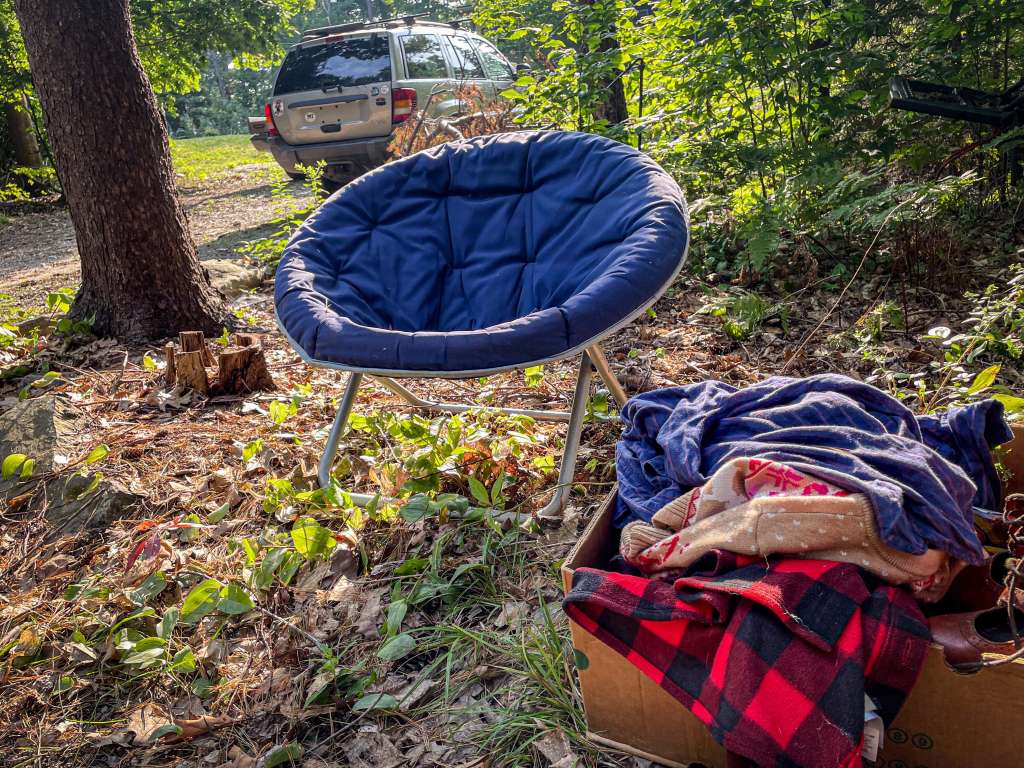
Some cheap plastic piece of crap
sitting in the weeds,
leaning against a wall
that hasn’t seen a fresh coat in twenty years.
Dwayne—whoever the hell he is—
probably punched a hole in the drywall,
kicked the dog,
yelled at the neighbors for parking too close.
they stuck him out here
to sweat it out.
but now the chair’s alone,
just like the rest of us.
EMBRACE THE SIGNS
Benny woke up before dawn, as he often did these days. The silence of early morning had become a refuge, a time when the world felt less demanding and more contemplative. But today, something was different. A phrase repeated itself in his mind like a mantra: “Embrace the signs.”
The words were so persistent that Benny rose from bed and scribbled them into the notebook he kept on his nightstand. “Embrace the signs,” he murmured under his breath, trying to decipher their meaning. Was it a dream? A message? A warning? Or was it something deeper—a nudge from the universe, or perhaps from his own fragmented sense of self?
The day began uneventfully. Benny worked at a small downtown bookstore, a part-time job that’s stretched into it’s second year, a placeholder until what came next. He helped visitors navigate the dusty aisles of the used book section, and enjoyed answering questions and making recommendations. Most of the time it was quiet work, solitary, but Benny didn’t mind. He had learned to live within the quiet, to find meaning in the stillness, to begin to feel comfortable within himself. Yet, as the hours unfolded, the signs started to appear.
It began with a magazine. Benny was shelving the newly delivered periodicals when his eyes caught a headline: “Follow the Path Ahead.” The phrase struck him as odd, almost personal. He stacked a weekly and another headline seemed to leap out: “Decisions Shape Destiny.” These phrases landed not just in his mind, but in his chest, like a pulse reminding him of something unnameable—a need to connect, to understand, to be.
By lunchtime, Benny began to dismiss it as coincidence. He walked to a nearby café, ordered his usual black coffee, and sat by the window. He liked to watch the passersby, but today, as he lifted his cup, he overheard snippets of conversations from other tables. “Sometimes you just have to trust the signs,” one woman said to her friend. Benny froze, his hand mid-stir. Then a man’s voice carried over: “You can’t keep ignoring what’s right in front of you.”
The words echoed within him, not as commands, but as questions. Was he ignoring something? What was right in front of him? The idea unsettled him, not because of its clarity, but because of its vagueness. What did it mean to “see” the signs? What did it mean to feel the weight of their presence in the fabric of his being?
That evening, Benny sat at home in his cluttered apartment, played some jazz, the phrase “Embrace the signs” looping in his mind. He opened a book at random, an old novel he’d been meaning to read. The first line his eyes landed on read: “Every journey begins with acknowledgment of the road.” He slammed the book shut and stared at it, unnerved. Was this an external force or his own subconscious unraveling?
For days, the signs persisted. They came in street graffiti, in the way leaves fell in patterns on the sidewalk, in words emphasized by strangers. A billboard near the bookstore changed its slogan to “The Future is Yours to Read.” Benny couldn’t tell if it was a genuine coincidence or a targeted assault on his sense of reality. Each moment seemed to demand something of him, not just attention, but an acknowledgment of existence itself, of being part of a larger whole.
Then, one night, the dream came. In the dream, Benny stood on a highway stretching endlessly into the horizon. The road was littered with signs, some pointing forward, others warning of danger. He felt paralyzed by the choices. A glowing sign ahead flashed: “The Way Forward.” Benny took a hesitant step toward it but stumbled as the road beneath him cracked open. He woke with a jolt, drenched in sweat, the disquieting sensation of having faced something too vast to comprehend.
The dream left Benny with a single question: What was the “way forward” in his own life? Was it a tangible action, or was it about redefining his perception—learning to see, feel, and be in the world with greater clarity and courage? Benny’s relationships had grown distant in recent years. After a bitter breakup with his long-term girlfriend Lily, he had retreated into himself, finding solace in routine and isolation. His friendships had dwindled to polite texts exchanged on birthdays and holidays. He hadn’t spoken to his brother, Sparky, in months—their last conversation had ended in an argument over something so trivial Benny couldn’t even remember it. These fractures gnawed at him, not because of guilt, but because they represented a disconnection from something essential: the shared experience of living. “Embrace the signs,” he muttered to himself again, this time with a tinge of sarcasm. What signs? What could they possibly want from him? Were they external forces trying to guide him, or internal reflections of his own neglected longings?
But the signs grew bolder. One afternoon, as Benny biked home from work, he passed an old diner he hadn’t noticed before. Its neon sign read: “Second Chances Served Daily.” Without thinking, Benny stopped and walked inside. The place was nearly empty, save for an older man nursing a coffee at the counter. Benny slid into a booth, ordered a pastrami sandwich, and looked around. The walls were lined with black-and-white photos of couples, families, and friends laughing and embracing. He felt a pang of longing—when was the last time he’d been part of something like that? His sandwich arrived, and with it, a small folded note. Bennie frowned and looked up at the waitress, but she had already turned away. He unfolded the note, his heart pounding.
It read: “Call him.”
Benny’s stomach twisted. The first name that came to mind was Sparky. He hadn’t even considered calling his brother; their relationship felt too fractured, too far gone. But the signs were relentless. He pulled out his phone and stared at the screen for what felt like an eternity. Finally, he dialed.
Sparky answered on the third ring. “Benny?” His voice was cautious, uncertain.
“Hey,” Benny said, his voice faltering. “I, uh, just wanted to check in. See how you’re doing.”
There was a pause. Benny braced himself for rejection, but then Sparky said, “I’m good. Better now, I think. It’s good to hear from you.”
They talked for an hour, about nothing and everything. By the time Benny hung up, he felt lighter, as though a weight he hadn’t realized he was carrying had been lifted. The call wasn’t just about reconnecting with his brother; it was about rediscovering a part of himself he thought he’d lost.
Over the next few weeks, Bennie began to “embrace the signs” more consciously. When he saw a flyer for a local photography class, he signed up, despite not having picked up a camera in couple of years. When a stranger at the bookstore mentioned a community running group, Bennie joined. He wasn’t athletic, but running was big in the town and it was something he wanted to try. Each step felt like an affirmation of his presence in the world.
The signs didn’t always lead to grand revelations or life-changing moments. Sometimes they led to small, quiet joys: a sunset hike that left him breathless, a photograph he might want to send to someone, a new friend he met at the photography class who shared his love for books or music. Each moment deepened his connection to the world, to others, and to himself.
One day, while organizing the store’s delivery of used books, Benny found an old postcard tucked inside a forgotten book. It showed a winding road disappearing into the distance. On the back, in faded ink, someone had written: “The journey is the destination.” Benny smiled. Maybe the signs weren’t about a specific path or goal. Maybe they were simply a reminder to pay attention, to feel, to live—to embrace his own existence as it unfolded.
As he left the bookstore that evening, Benny passed the diner again. The neon sign flickered, its message changing just as he looked up: “You’re on your way.”
For the first time in years, Benny believed it.

The harmonica, a small but mighty instrument, has left an indelible mark on American music. Known for its distinctive, soulful sound, the harmonica is often associated with blues, folk, country, and rock music. Its appeal lies in its portability, affordability, and versatility, allowing musicians to express complex emotions across a range of genres. Although its origins are rooted outside the U.S., the harmonica became an essential part of American music in the 19th and 20th centuries, shaping genres and adding depth to musical expression.
This week Next To Silence is not so much a history of the harmonica in American Music as a appreciation, which features a collection of some of my favorite tunes that feature the mouth harp. We’ll hear the harmonica featured in different genres – blues, pop, rock, movie soundtracks, country, and African music.
Playlist for the week of November 18, 2024:
00:00:00 John Mayall – Room To Move
00:07:01 Little Walter – Juke
00:09:43 Stevie Wonder – Fingertips Pt 2
00:12:52 The Lovin’ Spoonful – Lonely – Instrumental
00:16:11 Captain Beefheart & His Magic Band – Gimme Dat Harp Boy
00:19:42 The Paul Butterfield Blues Band – Born in Chicago
00:27:47 Ennio Morricone – Man with a Harmonica
00:26:13 Toots Thielemans – Scotch On The Rocks
00:32:15 Cream – Rollin’ and Tumblin’ – Live
00:37:16 Charlie Musselwhite – Christo Redemptor
00:40:34 John Barry – Midnight Cowboy
00:43::19 Sonny Boy Williamson II; The Yardbirds – Mister Downchild – Live
00:47:26 SOBA; Moussa Koita; Jean-Emile Biayenda; Vincent Bucher – Tounga
0:51:41 – Canned Heat – On The Road Again
00:55:04 The Rolling Stones – Midnight Rambler
01:01:54 The Doobie Brothers – Long Train Runnin’
01:05:20 Led Zeppelin – When the Levee Breaks
01:15:09 Joe Filisko & Eric Noden – Destination Unknown
01:17:4 Billy Joel – Piano Man
01:23:21 The J. Geils Band – Whammer Jammer
01:25:57 Bruce Springsteen – The Promised Land
01:30:24 Blues Traveler – Run-Around
01:35:01 Bob Dylan – I Want You
01:38:05 The Beatles -Love Me Do
01:40:24 Jethro Tull -Some Day the Sun Won’t Shine for You
01:45:53 Charlie McCoy -Orange Blossom Special
Stretched skin against the abyssal black,
stitched by unseen hands,
tensions hum in silence,
holding stories of wind and weight.
The light grazes its surface,
a quilt of impermanence,
bound in fragility,
defiant against the void.

Portsmouth, New Hampshire
 Boho Dreams of Space and Time