I like to think of them finishing up their shift, punching out of whatever clock the sun keeps in the sky, maybe gossiping a little about the new patch of clover down by the fence post.
Then, without ceremony, they curl themselves into the purple like a guest slipping under a heavy quilt in an unfamiliar house, the air full of quiet and whatever dream bees dream.
Meanwhile, I’m here at the window, pretending to work, watching the day close shop—
It was a peaceful neighborhood

until the signs started speaking—

first they warned us,

then they laughed.

Now a child runs forever—

a small joke from the underworld.

But even the joke feels holy

when the light hits right—

when the mind forgets itself

and floats like clouds

through the blue dome

of a sticker someone placed

with quiet mischief.

The sign says SLOW.

The sign says CHILDREN.

But it’s the skull that knows.

Knows the world slows down

only after.

Knows how warning

is a privilege

disguised as concern.

Is it still running—

that figure on the sign,

some version of us,

once wind-stung,

barefoot, unafraid?

We wave,

as if it matters.

I saw him once—

third-grade me, maybe,

invisible cape, skinned knees,

halfway to Mars

and all the way lost in joy.

He’s still out there,

dodging traffic

and dreaming about outer space,

or cotton candy,

or something better.

The sign still holds

the shape of a child

leaning into the forever

no one meant to promise.

We keep walking.

We obey.

We forget.

But the child,

skull full of clouds,

keeps running
into the deep,

unspoken now.
The bed sagged like a cracked raft,

smelling of rust, salt, and lost time.

The other side was hollowed out,

a dent where someone used to dream.

The air bent yellow at the edges.

A radio somewhere cracked and whined —

low country and western misery,

a voice leaking out about someone who never came home.

The floor leaned west,
always west,

because that's where things go
when they’re too tired to fight.

The clock on the wall had stopped
sometime last night,

but no one noticed,
not even the dark.

The sea dragged the dead nets,
and the chain inside the walls,
hummed low
against the bones of the room.

It ran through my empty wallet,

through my cracked teeth,

through the long thin cigarettes
burning themselves out.

It rattled whenever I breathed too hard.

The motel bible sat open on the nightstand,

a page torn loose,

a note scrawled in blue ink:

"don’t wait for me."

I tasted rust,

saw the green of rotting rope,

felt the floorboards creak
with a tired red sadness.

White gulls circled low,
no purpose left;
their shadows vanish
into the sea’s forgetting.

I thought about standing up,
walking toward the window,
singing along
with the sad broken radio.

I didn’t move.
The tide had already
taken everything.
Shadow rattles through dreams

of a non-trivial world—

a lattice of wires and heat exchange,

ragtime pulsing beneath

the tireless rhythm

of rails and ties.

Through this windowed trespass

of industrial apprehension,

we pass ductwork like iron lungs,

humming with function,

resigned to necessity.

We ride inoculated, immune

by the promise of arrival,

fleeing once again

the rust-backed burden,

the redbrick breath

of imposition.
She came through the lobby

in heels that sounded like secrets,

dragging a suitcase
that probably held regrets

neatly folded

next to a book of spells.

The clerk said she had

that look—
like she’d once been painted

on the side of a bomber plane,

or whispered about

in backseats and divorce papers.

They gave her Room 237,

because of course they did.

Where else would a woman like that stay

but down the hallway

that never quite ends?

She ordered champagne at midnight,

left no tip,

and signed the bill

“Love, Karma.”

Some say she rewrote dreams.

Others, that she stole them.

Mostly, she just waited—

watching time melt down the window

like candle wax.

Men dropped around her
like poker chips at a rigged table,
grinning through the gamble,
and left with their names

misspelled in the mirror.

When the flowers stopped

and the world got bored

of her perfume and promise,

she slipped into the velvet-lined box

beneath the lobby gift shop,

a mannequin saint

with sale tags on her sins

and a crucifix worn

like costume jewelry.

Now tourists lean in,

take photos,

whisper,

"Wasn’t she someone?"

And somewhere—

behind the front desk,

or in the static of the lobby jazz—

the universe clears its throat,

adjusts its tie,

and laughs,

quietly,

into its infinite hand.
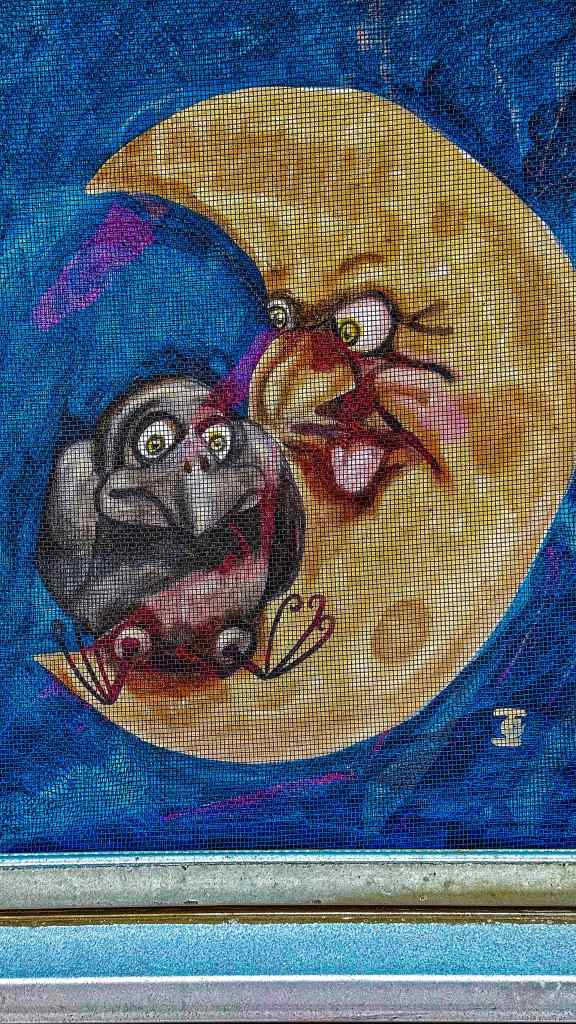
1. The moon said: “Your shadow has been impersonating you.”
The crow cocked his head, pecked once at his feet, and stared behind himself like betrayal might be hiding just past the tail feathers.
2. The moon said: “I watched you steal fire from a god then choke on the smoke.”
The crow flared his wings, feathers bristling like broken knives. He remembered that sky— the burning alphabet, the gods cursing in reverse, the ash that clung to his beak for a thousand silent winters.
3. The moon said: “Worms dream louder than birds.”
The crow blinked hard, his eyes fogged over like windshields in winter, and he let out a caw that sounded more like a question than a cry.
4. The moon said: “The sky is a lid. You’re inside the jar.”
The crow twitched. One wing spasmed, his claws tightened on the crescent— clutching not for balance, but for the memory of escape.
5. The moon said: “You were never born. You’ve just been very committed to the act.”
The crow went still. His pupils dilated into voids. He opened his beak, but nothing came out. Even silence abandoned him.
6. The moon said: “You’ve been flying in circles because you’re the message, not the messenger.”
The crow froze. No blink. No twitch. As if time had taken a breath.
Inside his bones a black wind stirred— the old hunger, the laughing void that once tore language from the sky and fed him its feathers.
He did not speak. He did not move. He simply fell inward— like a stone into still water— and from somewhere deeper than flight, he heard it:
They were Georgia boots, Comfort Core. No comfort left in that label now. The soles gone to hell, inlay peeled like burnt skin on a summer drunk.
He used to wear 'em to the docks— not for the job but to look like he had one. Said the boots gave him posture even when he had no spine.
The bench was his confessional. "Seven cups," he muttered once, “they all looked good in the morning fog."
Money. A woman who called him “baby.” A trailer with a flag and a fridge full of cheap beer. A crappy transistor radio always tuned to the same static. He liked the noise more than silence— said silence reminded him of his old man’s fists and the day he slammed the door and never came back.
She came like the others— eyes like storm warnings, barefoot in winter, mouth full of someone else’s songs. He loved her the way you love a fire: too close, too long, burned down to bone.
Every choice a ghost that kissed his cheek and walked off with his wallet.
He died right there, on the bench that knew his weight, where the pigeons ignored him and the cops didn’t bother.
Boots side by side, one insole flopped out like a tired tongue. A half-smoked cigarette still warm in the groove of the slats. No note. No name. Just a man who picked the wrong cup too many times.



 Boho Dreams of Space and Time